Research question
How can a manufactured-home community study heat exposure in a way that helps it prioritize communication and property checks without implying that a weather alert proves unsafe indoor conditions? Heat affects residents, common areas, vehicles, equipment, and maintenance schedules differently. A research record should therefore connect public context to local observations while preserving the boundary between administrative support and medical or building-performance advice.
Evidence base and methodology
The source set includes the National Weather Service's heat safety guidance, the CDC's heat and health tracker, EPA's heat island information, the Department of Energy's energy saver guidance, and HUD's manufactured housing resources. These sources establish public-health and housing context, not a diagnosis of any residence.
I separated the evidence into regional conditions, shared-space observations, resident-reported experience, and property-response records. Facts are statements supported by a public source or a dated local record. The conclusions about what makes a useful queue are analysis. The scope excludes medical triage, HVAC repair instructions, indoor-air certification, and claims about a particular home's habitability.
Regional alert versus local condition
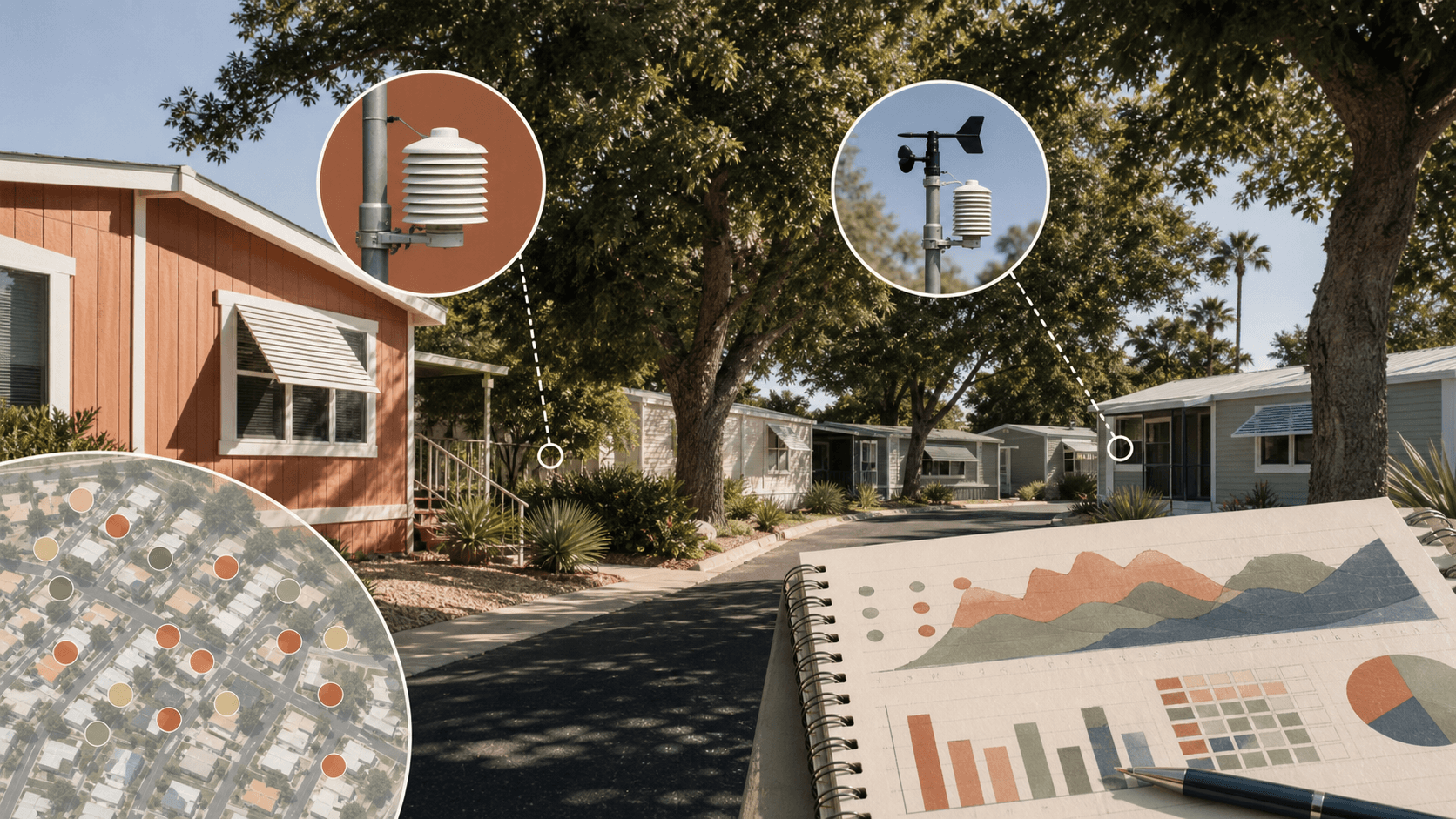
A heat advisory, forecast, or index provides a time window and geographic context. Save the issuing authority, URL, issue time, and affected area. Do not rewrite a regional alert as if it were a reading inside a home. A local thermometer may be useful for a defined measurement, but it still represents one point, one height, one exposure, and one moment. Record method and location before comparing values.
Shade is similarly specific. A tree canopy, covered waiting area, reflective roof, or unshaded pavement can affect how a person experiences a common area, but an observation that “the west sidewalk has no afternoon shade” is not a complete heat-risk assessment. It is a useful property fact that can inform a review of communication, access, landscaping, or maintenance.
Preserving resident reports respectfully
Residents may report a hot room, a failed cooling unit, dizziness, inability to access a cool space, or concern for a neighbor. Record the report as received, with consent and only the minimum personal information needed for follow-up. Separate the symptom from any explanation. “Resident reports the bedroom is unusually hot at 3 p.m.” is different from “home has inadequate insulation.” The latter requires an appropriate assessment.
Any report of a medical emergency or immediate danger should be directed to emergency services or qualified public-health guidance. An assistant can flag urgency, route a message for review, and track whether a response was acknowledged. It should not diagnose heat illness, prescribe hydration, promise a repair time, or decide that a person is safe to remain in a location.
Building a decision-ready comparison
Use a dated table with alert context, location, observation, source, response owner, and unresolved question. Compare repeated observations by time of day and place. A pattern of inaccessible shade at a bus stop may support a grounds review; repeated resident reports about one cooling system may support a maintenance route; neither pattern alone identifies the remedy. Record whether a communication was sent and what authoritative source it pointed to.
The research value comes from preserving non-events as well. If a park has an alert but no local reports, that is not proof of no exposure. It may mean communication worked, reporting was incomplete, or the condition was not observed. A good analyst avoids treating the absence of a ticket as the absence of a problem.
Review cadence and handoff
The routine should also record when a communication was reviewed and whether the intended audience received an authoritative next step. A park map can identify common areas for shade review, while a private queue can hold resident-specific concerns. Keep those layers linked by an event ID without copying personal details into a public summary. Review after each heat event and again before the next seasonal period so that a temporary alert does not become a permanent label. This cadence makes missing evidence visible and gives the next reviewer a defined starting point.
The same discipline applies to common-area improvements. A shaded bench, cooling-room notice, or adjusted maintenance schedule can be recorded as an action, but its presence should not be described as proof that every resident has equal access or that a health risk has been removed. Note the intended purpose, date, location, and follow-up observation. This gives the community a factual improvement history while leaving health outcomes to the appropriate professionals.
The record should also preserve access and communication gaps. If a cooling location was closed, a notice was not translated, or an update did not reach the intended audience, those are operational facts for review. They are not evidence of a medical outcome. Tracking them beside alert dates and local observations helps a community improve its communication routine while respecting privacy and keeping health determinations with qualified professionals.
Limitations and conclusion
Heat forecasts, health trackers, and guidance operate at different geographic and temporal scales. Resident accounts are important but subjective and private. Shade, surface temperature, building envelope, cooling equipment, age, health, and access to transportation can interact in ways this record cannot measure. The research does not replace medical, public-health, HVAC, electrical, or housing inspection expertise.
The evidence-led conclusion is that a credible heat-exposure routine keeps the public alert, local observation, resident report, and property action in separate fields. MobileHomeBiz can make the information easier to review by preserving timestamps, using neutral descriptions, and routing safety decisions to the right authority. That produces a more responsible queue than a single heat-risk score detached from the people and places it is meant to serve.