
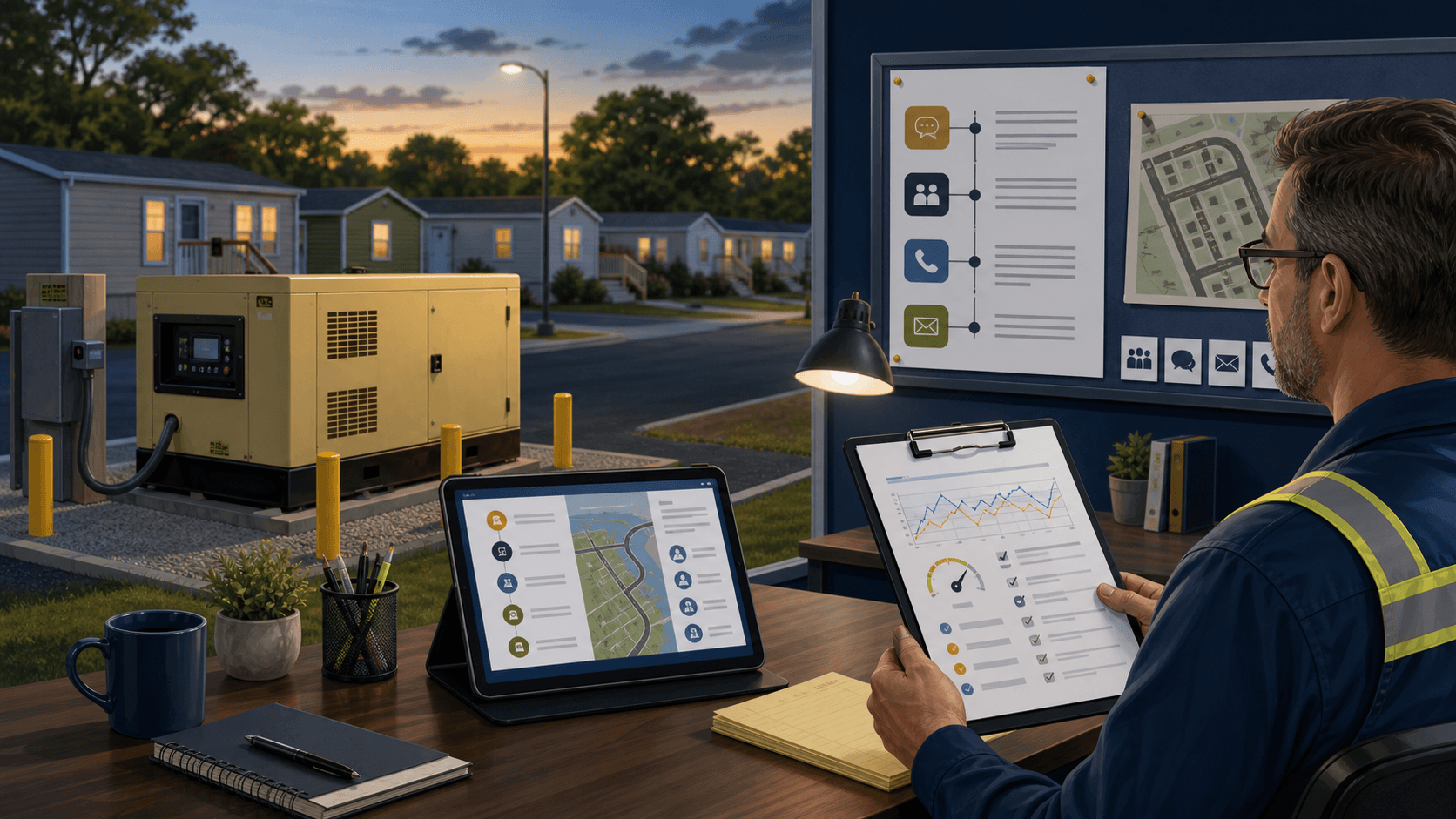
Do generator load-test records tell a mobile home park it is ready for an outage? They can answer part of that question. A dated test may show that equipment started, carried a stated load, or received maintenance. It cannot, by itself, show that every home, shared utility, access route, resident need, or communication channel will remain available. This distinction is central to useful research for manufactured housing operations.
Method and evidence scope
This brief compares guidance from the Federal Emergency Management Agency, the Occupational Safety and Health Administration, the National Fire Protection Association's public emergency power material, and the Department of Energy's resilience resources. It also uses Ready.gov emergency planning guidance. These sources describe preparedness concepts and safety boundaries. They do not inspect one park's generator or establish a local compliance result.
The research question is treated as a records question. What must a park preserve so an authorized reviewer can understand what was tested, under which conditions, and what remains outside the test? The answer is not a single pass/fail field. Equipment, fuel, transfer controls, protected circuits, vendor records, weather context, access, resident communication, and escalation contacts belong in linked records.
What a load test can show
A test can document a start sequence, operating duration, observed load, voltage or frequency readings when measured, fuel or battery condition, alarms, and corrective actions. Its usefulness depends on the scope. A no-load start test answers less than a test of the circuits the generator is expected to support. A test performed in mild weather may not reflect a storm response. A maintenance checklist may confirm service tasks without confirming a full operational scenario.
The date and conditions also matter for comparison. A result from a scheduled monthly check should not be presented as the same kind of evidence as a post-storm inspection. Record whether the equipment was exercised automatically or manually, whether a transfer occurred, and whether any protected load was actually observed. If a field is missing, write “not recorded.” That is a useful finding for the next review and safer than reconstructing the event from memory.
The record should name the equipment identifier, test date and time, technician or responsible role, method, stated load, observations, deficiencies, and follow-up. If a vendor document uses a standard or form, retain that reference rather than paraphrasing it into “passed.” A correction that remains open should stay open until the person responsible verifies it.
What it cannot show
No equipment record proves that a community is safe in every emergency. A generator may support common-area lighting but not individual homes. A transfer switch may require a different review from the engine. Fuel delivery can be interrupted. Exhaust, carbon monoxide, fire separation, wet conditions, noise, and access can create hazards. Medical equipment, elevators, water systems, gates, pumps, and communications may have separate dependencies.
FEMA and Ready.gov encourage planning around hazards, communications, supplies, and responsibilities. OSHA provides workplace safety information that matters when staff or contractors operate around electrical and fuel equipment. Those sources support a plan and escalation structure, not a promise that an outage will have no effect. The public article should state that limit plainly.