
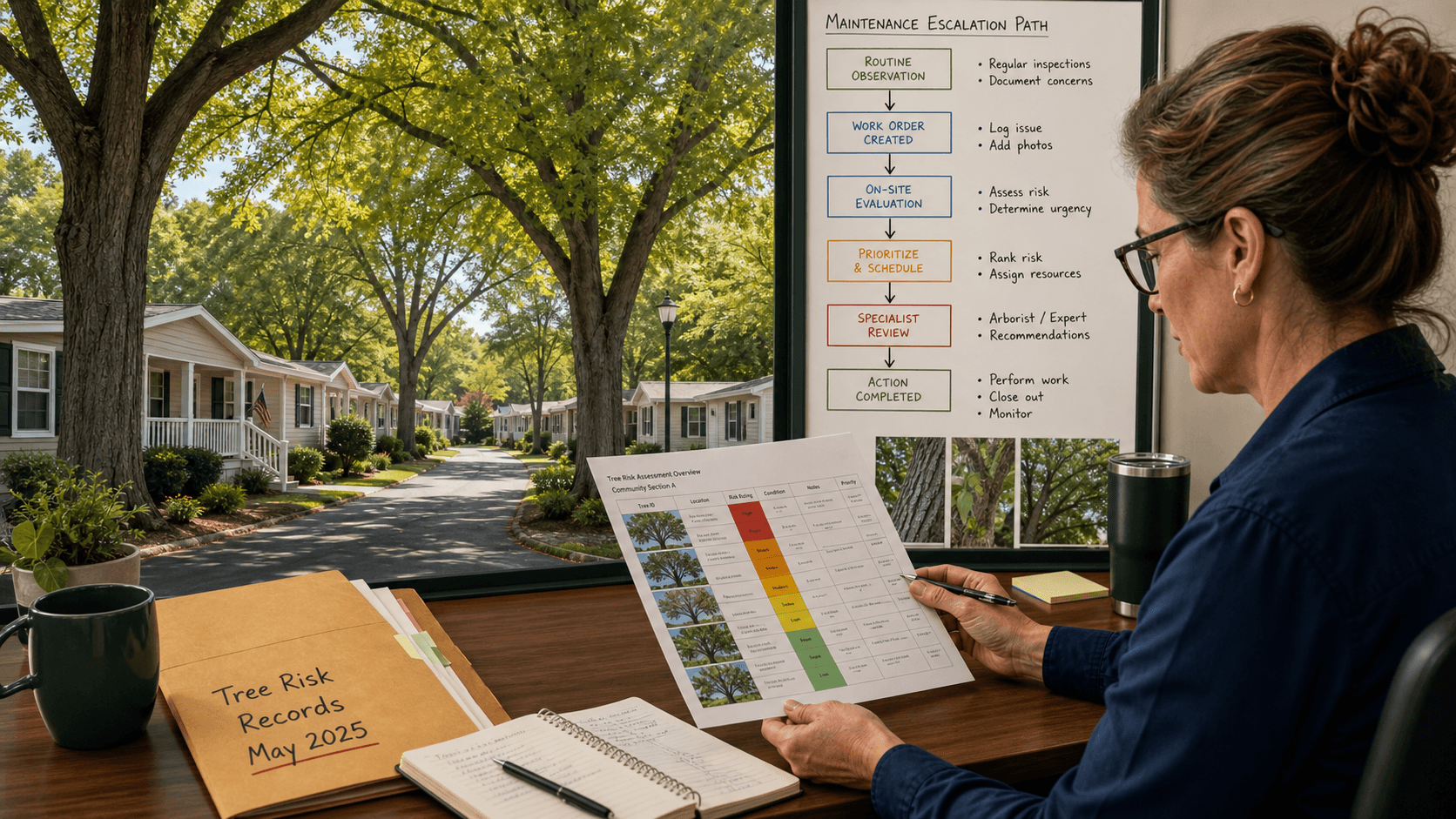
Can tree-risk records help a mobile home park prioritize maintenance? Yes, if the record is treated as a triage signal rather than a diagnosis. Trees near manufactured homes, utility lines, roads, and shared spaces create a practical need for consistent observations. They also create a boundary: an assistant can organize evidence and schedule a review, but should not declare a tree safe, hazardous, or ready for removal without the right expertise.
Evidence and method
This research brief uses public guidance from the U.S. Department of Agriculture's Forest Service, the International Society of Arboriculture's consumer-facing risk material, the Federal Emergency Management Agency's preparedness resources, NOAA weather information, and OSHA's general workplace safety resources. The sources provide context for records and escalation. They do not inspect a tree or determine liability at a particular community.
The method asks which observations are reproducible, which records can be joined, and which conclusions remain outside an administrative workflow. It distinguishes visible conditions, weather events, work orders, and professional assessments. That distinction is especially important where a tree is beside a home or access route and a delay could affect residents.
What an observation record should contain
Start with a stable identifier and location that does not expose a resident's personal information. Record the date, observer role, approximate condition, nearby assets, photographs if permitted, weather context, and the reason for review. “Large tree by lot 12” is less useful than a maintained asset identifier and a site-plan reference. The purpose is not to create a forestry diagnosis. It is to let the next reviewer find the same subject.
Consistency matters when several people observe the same grounds. A short observation vocabulary can distinguish branch, trunk, roots, clearance, obstruction, and storm debris without pretending to be an assessment standard. The vocabulary should be documented, and a reviewer should be able to amend it when a qualified professional supplies a more precise description. Keeping the original observation preserves the history of what was actually seen.
An observation may note dead limbs, visible lean, root disturbance, storm damage, interference with a line or road, or a resident report. It should use neutral language. “Possible limb failure risk, professional review requested” preserves uncertainty. “Tree is dangerous” asserts a conclusion that the observer may not be qualified to make. A clear escalation field identifies who reviews it and by when.
Joining weather and maintenance evidence
NOAA weather records can provide context for wind, rainfall, heat, or a storm date. They do not prove that a particular limb failed because of a particular event. FEMA preparedness guidance can help a community organize emergency contacts, access, and recovery records. USDA Forest Service material explains that tree condition, site, species, and weather interact. These sources inform the review; they do not replace an on-site assessment.
Link the observation to work orders, vendor visits, pruning history, utility notifications, road closures, and photos. Keep dates intact. A completed work order may show that a task was performed, but not that every adjacent tree was assessed. A vendor invoice may show service without describing the condition. These limits should be visible in the research queue.