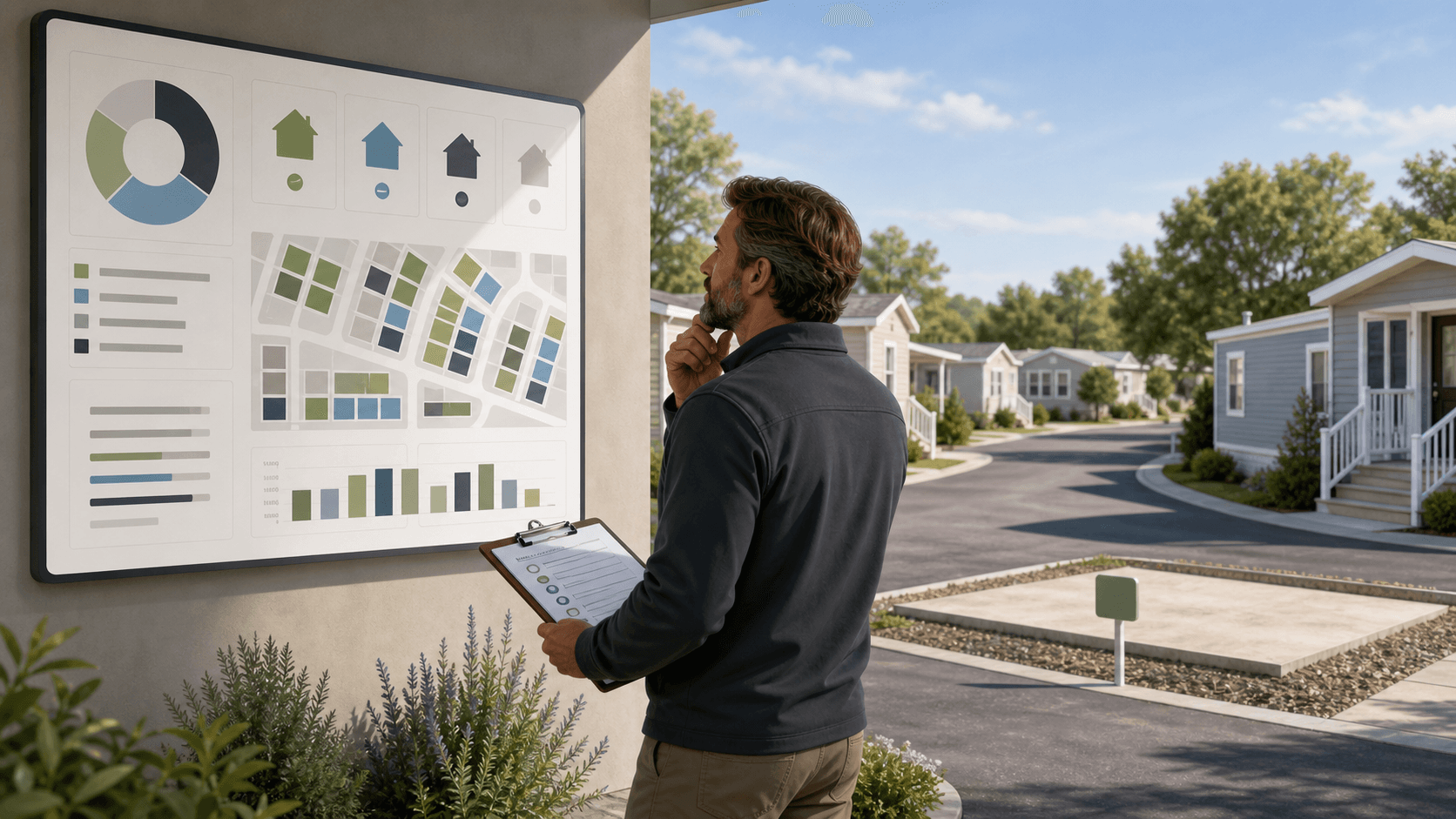
The research question
Can a manufactured home community use utility records to distinguish a real water-loss signal from a meter-reading error? Only if the record preserves the measurement definition, time period, meter identity, weather context, and the field observation that follows. A higher reading can reflect a leak, irrigation, occupancy change, a read-date shift, equipment error, or a change in how the account is grouped. Treating every anomaly as a confirmed leak creates avoidable resident communication and maintenance churn.
The practical question for an operator is therefore narrower: what evidence should be collected before a water-related work order is prioritized? That question keeps the company’s research routine connected to a real mobile home park operating decision while leaving diagnosis and repair to the responsible professionals.
Method and evidence scope
I reviewed EPA WaterSense material, the U.S. Geological Survey National Water Information System, the Bureau of Labor Statistics description of utility measurement data, the Department of Energy’s building-energy data guidance, and HUD’s manufactured-home installation standards. These sources do not form one unified leak-detection dataset. They explain conservation context, measurement systems, data definitions, and installation context.
The method is comparative: identify what each source can support, then define a local record that does not overclaim. The factual statements below are limited to the linked sources. The recommended queue structure is analysis based on those limits. It is not a plumbing diagnosis, billing ruling, resident finding, or promise of savings.
What counts as a useful signal
First define the reading. Record the meter or account identifier, units, read date, start and end dates, whether the reading was actual or estimated, and whether the account covers a home, a common area, or multiple buildings. A number without those fields cannot be compared safely with a prior number. If the billing period changed, mark the comparison as non-equivalent rather than calculating a confident trend.
EPA WaterSense provides conservation education and identifies household and system practices that can waste water. That context supports an investigation question, such as whether a fixture or irrigation routine deserves inspection. It does not establish that one resident or one home caused an observed increase. The USGS water-data system illustrates why station identity, time interval, and measurement type travel with a measurement. A community’s private meter log needs the same discipline even though it is a different system.
Weather is another separate layer. Hot or dry conditions can change irrigation and household use. Rain can reduce planned irrigation while creating other maintenance work. Record a weather source and period if it is used to explain a change, but do not treat regional weather as a precise explanation for every account. The record should say “possible context” until the local evidence is checked.
A defensible work-order sequence
The first queue state is “data check.” Compare the current period with like periods, inspect for read-date shifts, check whether the meter was replaced or reset, and confirm that the account grouping did not change. An assistant can perform these clerical checks and list exceptions. If a source file is missing, the correct state is “awaiting record,” not “no issue.”
The second state is “field observation requested.” The request should identify the meter, area, date, and approved observation needed. Avoid including unnecessary resident information in a shared queue. A photograph or note should be stored through the approved system, with access limited to people who need it.
The third state is “qualified review.” A plumber, utility operator, property owner, or other responsible professional determines what inspection or repair is appropriate. A manufactured-home installation standard may provide useful construction context, but an assistant should not infer compliance or direct a repair from a citation.
The fourth state is “evidence closed.” Closing a work order means the assigned action and record are complete, not that the cause is universally known. Record the finding, date, source document, unresolved limitation, and whether another check is scheduled. Keep the original reading and initial report so a later reviewer can see how the conclusion developed.
Analysis: why false certainty is costly
An anomaly-first workflow is tempting because it produces a neat list. But if a team labels every high reading as a leak, it may send inappropriate messages, duplicate vendor visits, or lose trust in the queue. If it labels every discrepancy as a meter problem, it can delay a necessary inspection. Separating measurement validation from field diagnosis lets the team move quickly without pretending the first number answers the question.
Use a short evidence table with columns for signal, measurement definition, comparison period, local observation, source link, owner, and next date. Add a confidence note such as “read-date mismatch found” or “field check pending.” Confidence is a description of the record, not a mathematical probability unless the method actually supports one.
Limitations and boundaries
Public conservation guidance is not a local consumption baseline. A USGS station is not a community meter. Weather context is not proof of causation. Manufacturer or installation standards do not answer a resident-specific billing question. Meter records can contain transcription errors, estimated reads, outages, or account regrouping. These limitations should be visible in the article and in any internal evidence brief.
MobileHomeBiz can help maintain a source log, compare dated records, prepare neutral requests, and route exceptions. It should not accuse a resident, disclose private consumption unnecessarily, promise a savings result, determine liability, or provide plumbing, legal, or billing advice. When a record may affect a resident’s rights or a financial dispute, route it to the owner and appropriate qualified reviewer.
Evidence-led conclusion
Utility data can identify a useful water-loss signal when the meter identity, units, read dates, account scope, and comparison period are intact. It cannot, by itself, distinguish a leak from a read error or explain who is responsible. The most reliable mobile home park routine is to validate the measurement, preserve weather and public-source context separately, request a bounded field observation, and let a qualified person determine diagnosis or repair. That chain makes the work queue more useful while keeping resident communication and operating decisions inside their proper boundaries.
Sources
- EPA WaterSense
- USGS National Water Information System
- BLS utility and price data
- DOE building performance resources
- HUD manufactured-home installation standards