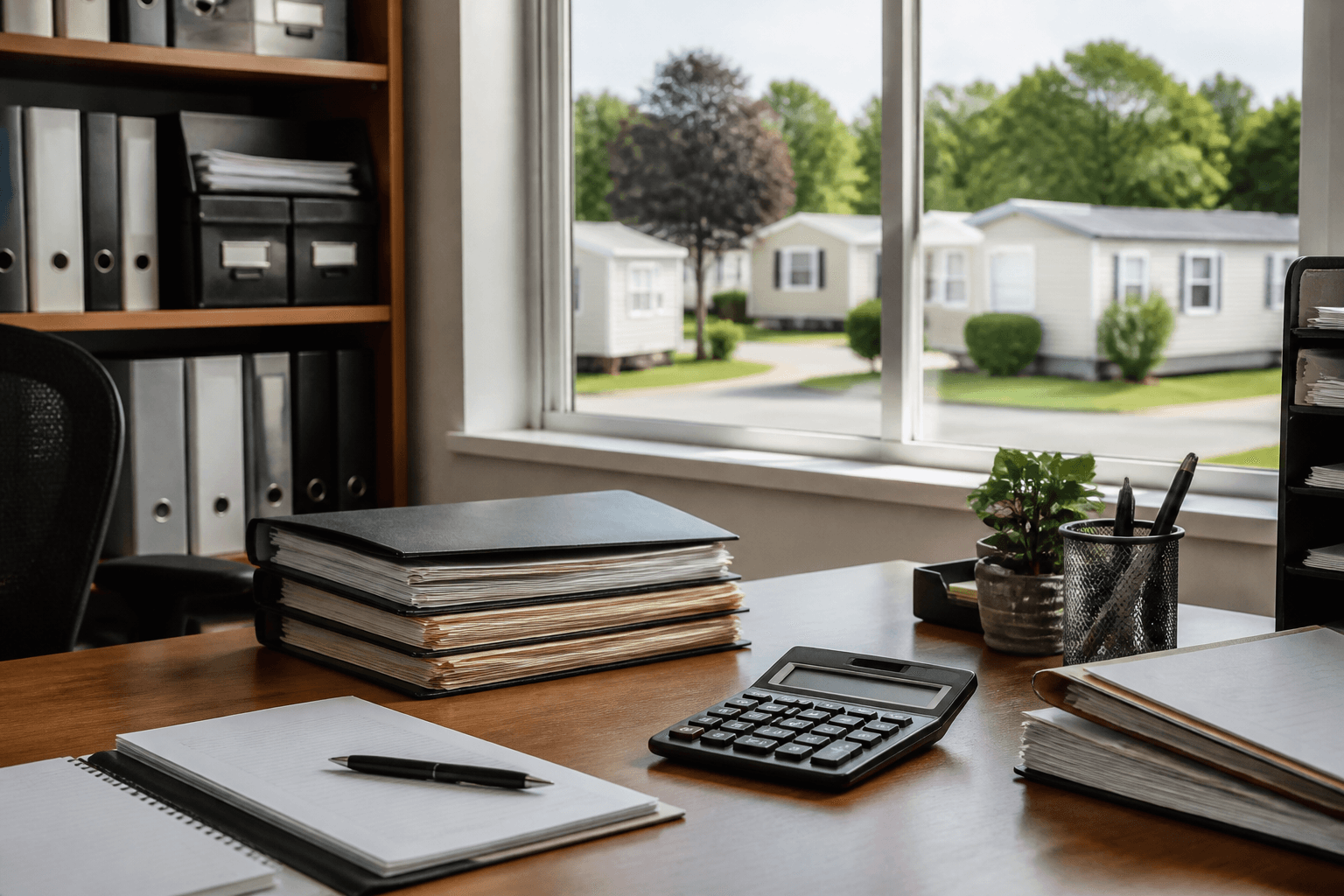
What a $30,000 Home Represents
At $30,000, buyers typically find:
- 1990s to early 2000s singlewides in moderate renovation condition
- Pre-2000 doublewides in full renovation condition
- Post-2000 singlewides in older condition needing work
- Well-priced homes in stable markets with active rental demand
A $30,000 home that rents for $800 to $950/month in a stable park produces strong cash-on-cash returns. After renovation (typically $8,000 to $12,000), the all-in cost of $38,000 to $42,000 against $850/month net income (after lot rent and expenses) produces 16 to 18 percent cash-on-cash returns. CFPB found chattel borrowers paid roughly 1.5 points more than mortgage borrowers in 2019.
Financing Options at $30,000
Chattel Loan
The primary institutional option for park-lot homes at $30,000.
Requirements:
- Post-1976 HUD code home with tags
- Credit score 620+ (better rates above 680)
- Documented income
- Home in acceptable condition
- Park on lender's approved list
Rate and payment examples ($27,000 financed, 10% down):
| Rate |
Term |
Monthly Payment |
Total Interest |
| 8% |
15 yr |
$258 |
$19,440 |
| 10% |
15 yr |
$290 |
$25,200 |
| 10% |
20 yr |
$261 |
$35,640 |
| 12% |
15 yr |
$324 |
$31,320 |
💡 Did You Know? A 2 percent rate difference on a $27,000 loan over 15 years is approximately $8,000 in additional interest.
Best lenders at this amount: 21st Mortgage, Triad Financial, Cascade, local community banks and credit unions that serve manufactured housing.
FHA Title I
Government-backed chattel loan producing better rates than conventional chattel.
- Minimum credit: 580 (620+ preferred)
- Down payment: 5% minimum ($1,500 on $30,000 home)
- Rate advantage: typically 1 to 2 percentage points below conventional chattel
- Sample payment: $28,500 financed at 7.5%, 15 years = $264/month
FHA Title I is the best available rate for buyers who qualify. The government backstop allows lenders to accept lower credit scores and offer more competitive pricing than conventional chattel.
Seller Financing
Still available and often preferred by motivated sellers at this price point.
- No lender approval process required
- Fastest closing (1 to 2 weeks)
- Terms set by negotiation: typically 10 to 15 percent rate, 5 to 10-year term
- Sample: $25,000 financed at 12%, 7 years = $453/month; at 10 years = $330/month
Cash
For investors, $30,000 is accessible as an all-cash purchase for those with savings, a HELOC on another property, or a business line of credit. Cash acquisition eliminates all financing cost and produces the highest return on capital.
Income Qualification at $30,000
For chattel loan qualification, lenders typically require total housing cost (loan payment plus lot rent) to not exceed 35 to 45 percent of gross monthly income.
Example:
- Loan payment: $274/month
- Lot rent: $375/month
- Total housing: $649/month
At 35% DTI: minimum gross monthly income approximately $1,854/month ($22,248/year)
At 45% DTI: minimum gross monthly income approximately $1,442/month ($17,304/year)
A $30,000 home is accessible to buyers with even modest incomes, which is a key reason this price point serves a broad buyer and tenant pool.
Down Payment Strategy
10% down ($3,000): Standard chattel loan requirement. Keeps cash outlay minimal. Produces $27,000 loan amount that clears most lender minimums.
20% down ($6,000): Some lenders offer better rates or terms with higher down payments. Reduces loan amount to $24,000 and monthly payment proportionally.
5% down ($1,500): Available with FHA Title I. Reduces upfront cash requirement. Best for buyers with limited savings who qualify for FHA.
0% down: Possible with seller financing if the seller is sufficiently motivated. Rare but negotiable.
For Sale Listings at This Price Point
When using for sale listings resources to find $30,000 homes, filter for homes priced at $25,000 to $35,000 to find both asking price and negotiated deals in this range. Homes listed at $35,000 that have been on the market 30+ days often close at $28,000 to $32,000 after negotiation. Days-on-market is your best friend as a buyer at this price point.
Finance $40,000 Mobile Home Comparison
At $40,000, the loan amount (with 10% down) rises to $36,000, which opens a wider range of chattel lenders and provides access to better rate programs. The manufactured home market has more financing options at $36,000 than at $27,000, and some lenders with higher minimums become accessible. See the finance $40,000 mobile home guide for how the options expand at that price point.
Common Mistakes at the $30,000 Price Point
Not comparing across multiple lenders at this loan size costs real money. A 2 percent rate difference on a $27,000 loan over 15 years is approximately $8,000 in additional interest. Rate shopping takes a few phone calls and is worth thousands.
Using a generic home inspection rather than a manufactured home specialist creates gaps in the inspection. At $30,000, the home likely has deferred maintenance. A specialist inspector identifies subfloor issues, marriage wall problems (doublewides), HVAC age, and belly pan condition that a generic inspector may miss.
Not verifying park approval before applying for financing wastes everyone's time. If the park manager will not approve the buyer, the loan cannot fund. Confirm park approval status before submitting a loan application.
Accepting seller financing without a written agreement creates legal exposure. Verbal seller financing is unenforceable. Put every term in writing: amount, rate, term, payment schedule, default provisions, and what happens to the title if the buyer defaults.
Step-by-Step Qualification Walkthrough
Getting your financing approved on a $30,000 manufactured home is a process with clear steps. Buyers who prepare in advance move faster and get better terms than those who start the process without documentation in order. At the $27,000 loan level, lenders move quickly when applications are complete. Incomplete applications sit in the queue.
Step 1: Pull Your Credit Report
Get your free credit report at AnnualCreditReport.com. Review all three bureaus (Equifax, Experian, TransUnion) because manufactured home chattel lenders may check any of them. Dispute errors immediately. A single incorrect delinquency can drop your score 20 to 40 points, which may push you from a 680-tier rate to a 620-tier rate, adding roughly $3,000 to $5,000 in total interest on a $27,000 loan. Allow 30 to 60 days for disputes to resolve before applying if you find significant errors.
Step 2: Calculate Your Debt-to-Income Ratio
Your DTI is total monthly debt payments divided by gross monthly income. At this price point, the math is straightforward: a $274/month loan payment plus $375/month lot rent totals $649/month in housing costs. At 35% DTI, you need roughly $1,854/month gross income just for housing. Add existing debts (car payment, credit cards, student loans) on top of that. Know your number before you call a lender.
Step 3: Gather Income Documents
W-2 employees need two years of W-2 forms and two recent pay stubs. Self-employed buyers need two years of complete federal tax returns. Lenders average the two-year net income figure for self-employed applicants, so a year where income dropped significantly will be factored against you. Have documents ready before you contact lenders. Waiting on documents is the most common reason applications stall at this price point.
Step 4: Confirm the Home Qualifies
Not every $30,000 manufactured home qualifies for chattel financing. The home must be post-1976 construction with HUD certification labels (the red or silver plates affixed to the home). The physical condition must meet the lender's minimum standards: no serious roof damage, functional plumbing, and no visible structural compromise. Parks must be on the lender's approved list. Check these three things (HUD tags present, condition acceptable, park approved) before applying.
Step 5: Apply to Multiple Lenders Simultaneously
At the $27,000 loan level, apply to at least three lenders: 21st Mortgage, Triad Financial Services, and one FHA Title I approved lender. Multiple applications within a 14 to 45 day window typically count as a single credit inquiry under mortgage scoring models. You want competing offers. At $27,000, even a half-point rate difference is worth hundreds over the loan term.
Step 6: Compare Offers on Total Cost, Not Monthly Payment
Lenders will pitch different terms. Compare APR (which includes fees), total interest over the loan life, and prepayment penalty terms. A 15-year loan at 10% costs $25,200 in total interest on $27,000. A 20-year loan at 10% costs $35,640 in total interest. The longer term lowers the monthly payment by $29 but adds $10,440 in interest. Shorter terms win unless the monthly budget is truly constrained.
Step 7: Lock Your Rate in Writing
Once you select a lender, get the rate lock in writing. Rate locks on chattel loans typically run 30 to 60 days. Confirm the lock expiration date. If closing is delayed beyond the lock period, some lenders charge an extension fee; others float you to the current market rate. Understand the risk before you lock.
Step 8: Schedule Inspection and Appraisal
Your lender will order an appraisal to confirm the home supports the $27,000 loan amount. Schedule your independent inspection at the same time. At the $30,000 price point, an inspection by a manufactured home specialist (not a generic home inspector) is worth the extra cost. The specialist will identify subfloor soft spots, belly pan condition, marriage wall integrity on doublewides, and HVAC age issues that a generalist misses. If the inspection reveals surprises, you need that information before you close, not after.
Step 9: Satisfy Conditions and Close
After appraisal and inspection, the lender issues a conditional approval. Typical conditions include proof of hazard insurance, park lease or park approval letter, and any outstanding income documentation. Satisfy all conditions within 48 to 72 hours where possible. Delays in condition resolution push closing dates and risk rate lock expiration. Review the closing disclosure at least 24 hours before signing and confirm all loan terms match what was quoted.
| Qualification Step |
What You Need |
Typical Timeline |
| Pull credit reports |
Free at AnnualCreditReport.com |
Same day |
| Calculate DTI |
Debt statements, pay records |
1 to 2 days |
| Gather income documents |
W-2s, pay stubs, or tax returns |
1 to 5 days |
| Confirm home eligibility |
HUD labels, park approval |
1 to 3 days |
| Apply to 3 lenders |
Full application package |
1 to 2 weeks |
| Compare and select offer |
Loan estimates from each lender |
3 to 7 days |
| Lock rate |
Written rate lock confirmation |
Same day |
| Inspection and appraisal |
Specialist inspector, lender appraisal |
1 to 2 weeks |
| Satisfy conditions and close |
Final documents, closing disclosure |
1 to 2 weeks |
Renovation Financing at the $30,000 Level
Most $30,000 manufactured homes need $8,000 to $12,000 in renovation before they reach the top of the rental rate range in their market. Homes at this price point have typically had deferred maintenance. The renovation scope directly determines the all-in cost and the final return. How you fund renovation is a meaningful decision.
Renovation Funding Options
The most straightforward approach is reserving cash at purchase. If you are buying a $30,000 home with a $3,000 down payment on a chattel loan, plan to have an additional $8,000 to $12,000 in reserve before you close. Using cash for renovation avoids additional loan interest and keeps the financing structure simple. At the $30,000 price point, the renovation often costs nearly as much as the down payment. Buyers who underestimate this get caught short after closing.
A second option is seller price reduction in lieu of repairs. If the inspection reveals $10,000 in needed repairs, negotiate a purchase price reduction of $8,000 to $10,000 rather than asking the seller to make the repairs. Sellers at $30,000 are often motivated. A price reduction gives you control of the renovation quality and timing rather than accepting the seller's cheaper fix.
A third option is a personal loan after closing. Personal loan rates from credit unions or online lenders typically run 8 to 14 percent for borrowers with 650+ credit scores. For $8,000 to $10,000 in renovation, a 36-month personal loan at 10% costs approximately $258/month. This adds to monthly overhead during the renovation period but allows you to deploy more cash toward a second acquisition rather than tying it up in renovation reserves.
A fourth option is using a business line of credit if you are investing through an entity. Lines of credit from community banks or credit unions that understand the manufactured housing space can fund renovation at interest-only rates of 8 to 12% while you complete the work and refinance into permanent financing.
Renovation ROI Analysis at $30,000
The renovations that generate the best return relative to their cost at the $30,000 price point:
Flooring replacement ($1,500 to $3,500) is the single highest-impact renovation for rental rate. Damaged or stained carpet and cracked vinyl are the most common reason a $30,000 home rents at $750 rather than $875. New LVP or laminate throughout transforms the rental appeal at modest cost.
Interior paint ($400 to $900) produces visible improvement disproportionate to cost. Fresh neutral paint covers stains, repairs minor wall damage, and makes the home photograph well for rental listings.
HVAC service or replacement ($300 to $600 for service; $2,000 to $4,500 for full replacement) is the most common functional issue at this price point. Homes in the 1990s to early 2000s vintage often have aging units. A working, efficient HVAC system is a non-negotiable for rentals in most markets.
Plumbing repairs and fixture replacement ($500 to $2,000) address the most common deferred maintenance: dripping faucets, running toilets, and aged supply lines. These are visible to tenants and affect rental quality perception.
A full renovation scope of $8,000 to $10,000 targeting flooring, paint, HVAC service, and plumbing puts a $30,000 home at an all-in cost of $38,000 to $40,000 renting for $875 to $950/month. The math works clearly at those numbers.
When the Renovation Does Not Pencil
If a $30,000 home has foundation settlement requiring pier work ($3,000 to $6,000), subfloor replacement across most of the home ($4,000 to $8,000), or a roof replacement ($3,500 to $6,000), the renovation scope can quickly reach $12,000 to $18,000. An all-in cost of $45,000 to $48,000 on a home you acquired for $30,000 puts you outside the return profile that makes the $30,000 price point attractive. In these cases, pass on the home and find one with a cleaner condition profile.
The rule of thumb: if structural or system repairs (subfloor, roof, foundation) exceed 25% of the purchase price, the economics rarely support the acquisition at $30,000.
Renovation Timeline and Rental Income Timing
A $30,000 home with $10,000 in renovation typically takes 4 to 8 weeks to prepare for rental. Plan for:
- Week 1 to 2: flooring removal and installation
- Week 2 to 3: paint, plumbing repairs, fixture replacement
- Week 3 to 4: HVAC service, final cleanup, photography
- Week 4 to 6: tenant screening and lease execution
Delaying the renovation by 4 weeks costs approximately $800 to $950 in lost rent. Renovation speed matters for returns. Identify contractors before you close so work begins within 48 hours of possession.
Common Questions Answered
What credit score do I need for a chattel loan on a $30,000 home?
Most chattel lenders require a minimum of 620. FHA Title I is accessible with 580+. Better rates (1 to 2 percentage points lower) are available with scores above 680 to 700. If your score is below 620, focus on seller financing while working to improve the score.
Can I finance a $30,000 manufactured home with no down payment?
Institutional lenders require a down payment. FHA Title I requires 5% ($1,500). Conventional chattel typically requires 10% ($3,000). Seller financing can sometimes be negotiated with no down payment for very motivated sellers, though this is uncommon. Most buyers at this price point can access a $1,500 to $3,000 down payment.
How long does it take to close a chattel loan on a $30,000 home?
Typically 3 to 5 weeks from application to closing. The main variables are lender queue time, appraisal or inspection scheduling, and park approval response time. Seller financing closes in 1 to 2 weeks.
Is $30,000 a good price to pay for a manufactured home as an investment?
It depends on the home's condition, the market's rental rates, and the lot rent. A $30,000 home that needs $10,000 of renovation in a market with $875/month rents and $375/month lot rent produces approximately 14 percent cash-on-cash (net $325/month on $40,000 all-in). That is a good return. A $30,000 home in a weak market with $650/month rents and $400/month lot rent does not produce adequate returns regardless of financing.
What is the best exit strategy for a $30,000 manufactured home?
For investors, owner-financed sale is typically the highest-return exit. An investor who buys at $30,000, renovates for $9,000 (all-in $39,000), and sells for $52,000 on owner financing with $10,400 down receives $10,400 at closing and approximately $600/month in note payments for 7 years. The total return is approximately $10,400 + $50,400 + balloon = $60,800 on $39,000 invested, for an IRR approaching 20 percent.
How does lot rent affect the investment at $30,000?
Lot rent is the most underestimated factor at this price point. A $30,000 home with $350/month lot rent produces a very different return than the same home with $500/month lot rent. At $500/month lot rent and $875/month gross rent, the landlord keeps only $375 before expenses. At $350/month lot rent and the same gross rent, the landlord keeps $525. Always model the lot rent impact before acquisition.
🎯 Key Takeaway: A $30,000 manufactured home with 10% down requires a $27,000 loan, which clears most chattel lender minimums.
Ready to Grow Your Portfolio?
The $30,000 price point is where the manufactured housing investment opportunity is clearest. The all-in cost is low enough that returns are strong, the financing options are wide enough that most buyers can qualify, and the home quality is high enough to attract stable tenants.
Get pre-approved, inspect thoroughly, negotiate based on the inspection, confirm park approval, and close efficiently. The $30,000 home done right produces returns that compound quickly into portfolio growth.
Book a Free Consultation with our team to discuss manufactured home acquisition and financing strategy at the $30,000 price point.